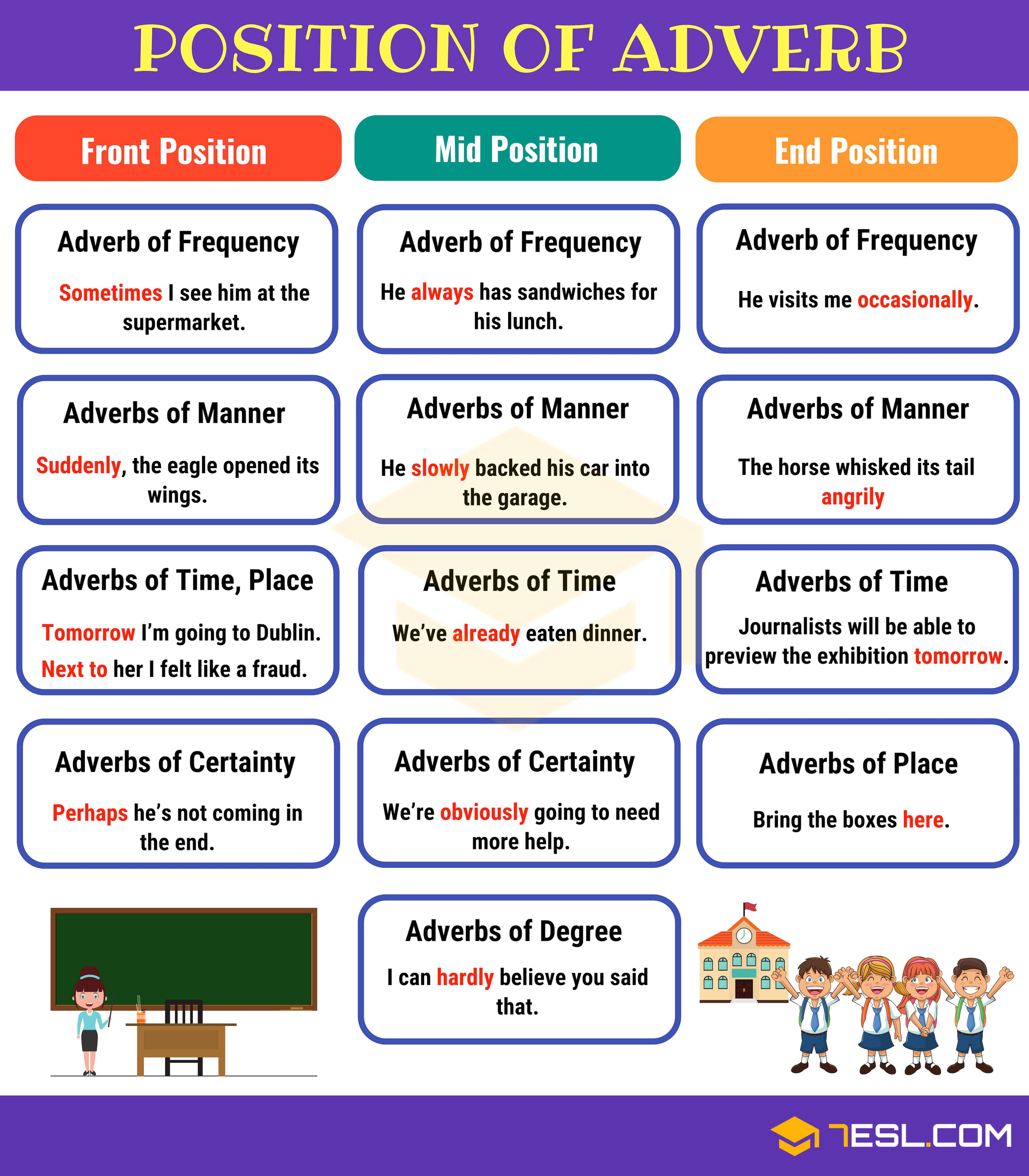
When deciding on where to place your adverb within a sentence it is important to remember to place it as near as possible to the word it is going to modify.
If the word you are modifying is a verb then the adverb should be placed in the middle of the sentence, for example:
- He swam effortlessly across the pool.
It is important to consider the adverb only as this can often be misplaced and has the ability to change the meaning of the sentence. Look at the two following examples:
- I only fed my bird.
- I fed only my bird.
The first sentence explains that I fed my bird but did nothing else with it, whereas the second sentence explains that I fed my bird and not any other birds.
Different types of adverbs and adverbials go in different positions in the clause. Lets learn these adverb positions in a sentence, also called adverb placement.
- The front position: before the subject of the sentence. It gives information in advance, to set the scene for the action that follows.
- The mid position: the adverb in this position is intimately connected with the verb, generally placed immediately before it. If there is an auxiliary verb, the adverb is placed between the auxiliary and main verb. In case there are two, it is placed between them. If there is a negative auxiliary, the adverb normally goes after the negative element, but we can emphasize negation by placing the adverb just before it.
- The end position: at the end of the sentence.