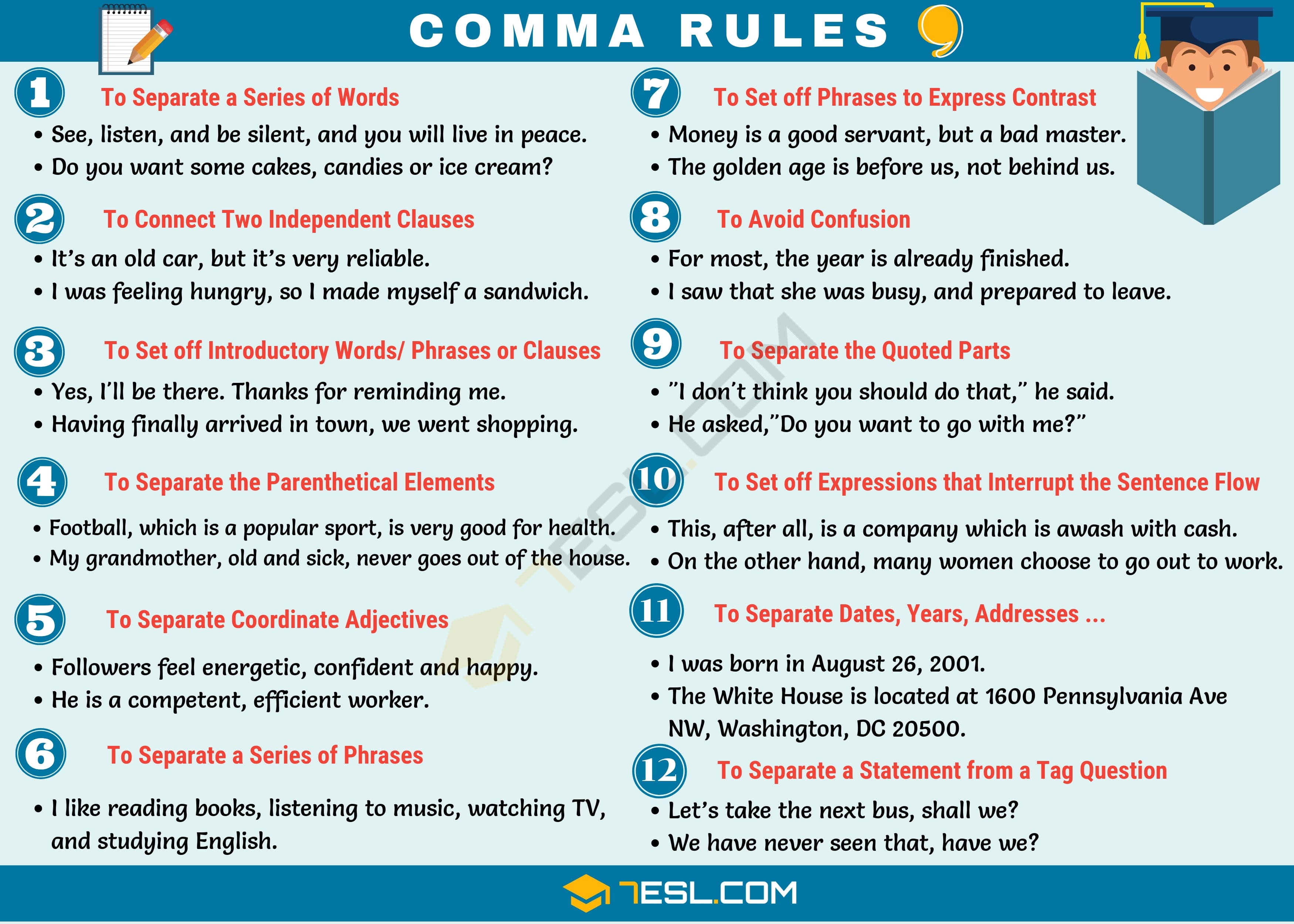
The following section will cover the instances when using a comma is unnecessary. We don’t have the space to tell you all the situations in which you shouldn’t use a comma, but we will highlight all the situations in which people most often use a comma, when it isn’t necessary. This should help you avoid making these same mistakes.
As a general rule though, whenever we use a comma in a sentence we should test if it works by reading it and taking an exaggerated pause where the comma is. If it feels unnecessary or as though it takes away from the meaning or tone of the sentence, then you should probably remove the comma and see if the sentence works better without it.
Common Mistakes with a Comma
Below are the most common mistakes that people make when using a comma.
When There Are Only Two Items in a List
People often get in the habit of adding a comma whenever there are more than one item/object/subject/character in a sentence, and people can be tempted to add an unnecessary comma here. For example:
- From the store, I just need to pick up lipstick, and eyeshadow. (incorrect)
This comma is unnecessary because there are only two items on this list. We should write it as:
- From the store, I just need to pick up lipstick and eyeshadow. (correct)
Notice how the first comma remains. That is because ‘From the store’ is an introductory phrase that is a subordinate clause, because it makes no sense without the rest of the sentence. So, a comma is necessary here, but not to separate the two items in the list.
When Two Actions Relate to One Subject
If there are two actions that both relate to the same subject of the sentence, then a comma is unnecessary. However, plenty of people still make this mistake. For example:
- I walked home through the park, and sang along to my music. (incorrect)
A comma is unnecessary in this case because both actions refer to the subject ‘I’. So we should write it as:
- I walked home through the park and sang along to my music. (correct)
After the Last Item in a List
If a list is given and then the sentence continues after the list, people are tempted to place a comma after the last item. This is, however, a mistake, and a very common one at that. For example:
- Jamie, Daniel, and Lisa, were terrified the moment they stepped inside. (incorrect)
The problem with this mistake is that pausing after Lisa where the comma is somewhat natural. So when reading back your work to identify the mistake, it may be difficult. Just remember, that a comma is never necessary before the first item in a list, or after the last item in a list. We should write it as:
- Jamie, Daniel, and Lisa were terrified the moment they stepped inside. (correct)
Learn more:
- Does “as well as” need a comma?
- When to use a comma before “and”
- When to put a comma before “while”
- How to fix a comma splice.
- Should you use a comma before or after but?
- When do we use a comma before or?
- When do you put a comma before Which?
- When do you put a comma before because?
- When you are writing, should there be a comma before Such As?
- When to use a comma before “so”
Comma Rules Chart