When we are dealing with main verbs, there are different forms in which they can come. We are now going to take a look at each of these forms in a little more detail.
Infinitives
The infinitive form of a verb is that state in which it is originally found. In English, this is often with the word to in front of the verb, for example to run, to see, to have, to live.
What is a To-Infinitive?
A to-infinitive is a verbal consisting of to + a verb, and it acts like a subject, direct object, subject complement, adjective, or adverb in a sentence.
We use the infinitive:
- To indicate the purpose of an action
- As subject of the sentence
- As direct object of the sentence
- As subject complement
- As an adjective
- As an adverb
- After adjective
- After object that is noun or pronoun referring to a person
- Used with question word
Verbs Followed by Infinitives
List of commonly used Verbs Followed by Infinitives
- Attempt
- Ask
- Arrange
- Beg
- Begin
- Care
- Choose
- Claim
- Consent
- Continue
- Dare
- Decide
- Demand
- Deserve
- Dislike
- Expect
- Fail
- Forget
- Get
- Hesitate
- Hope
- Hurry
- Intend
- Learn
- Like
- Love
- Manage
- Mean
- Neglect
- Need
- Offer
- Plan
- Prefer
- Prepare
- Pretend
- Proceed
- Promise
- Propose
- Refuse
- Remember
- Seem
- Start
- Stop
- Struggle
- Swear
- Threaten
- Try
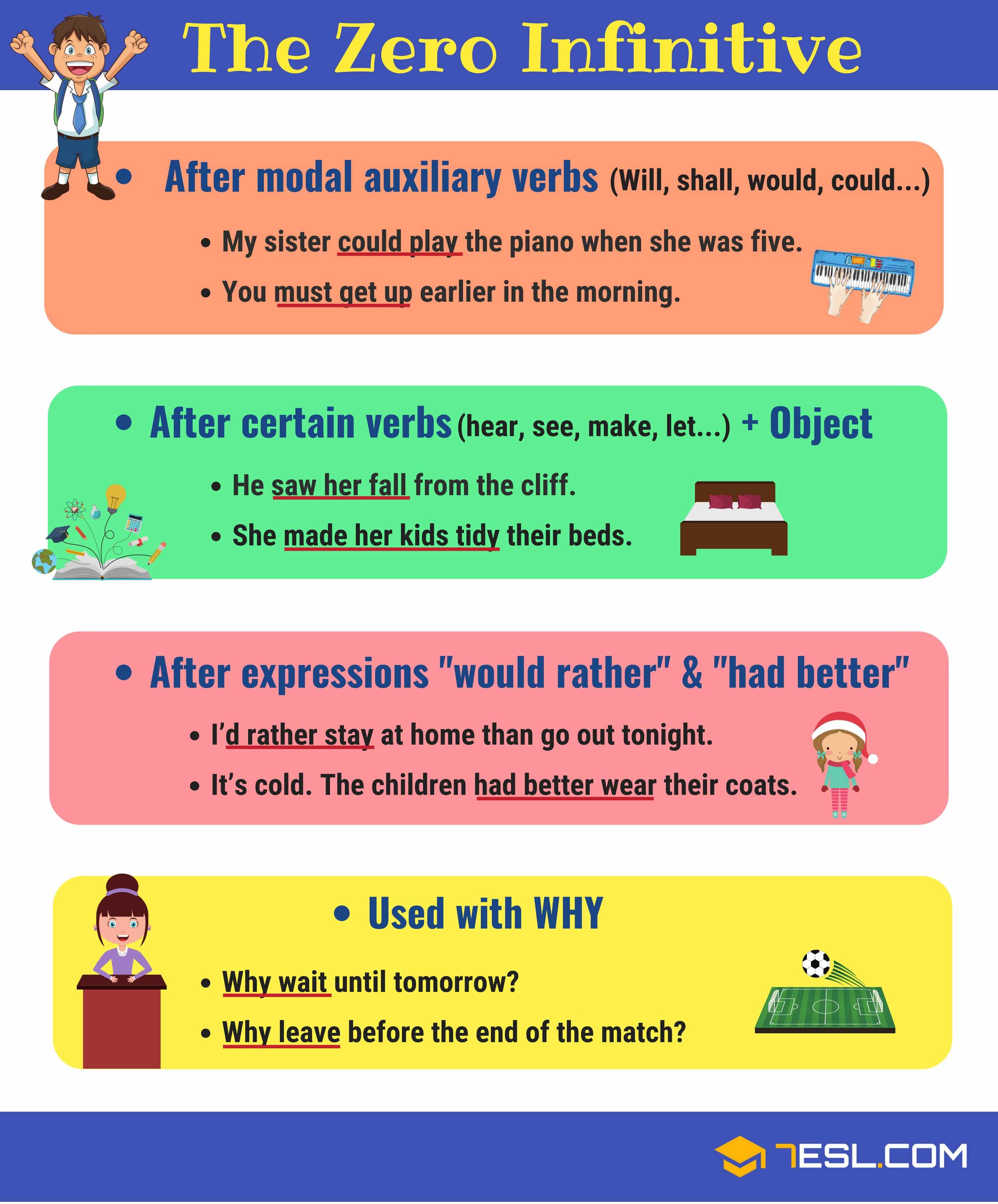
Zero Infinitive
We use the Zero Infinitive when:
- After modal auxiliary verbs
- After the object after certain verbs, such as hear, see, make, let
- After verbal idioms would rather and had better
- Used with WHY
Zero Infinitive in English