The reflexive pronoun will end in -self or -selves and is used in reference to another pronoun. Words within the category are himself, herself, themselves, yourself/ves, myself, itself.
- He takes care of himself.
- She can do it by herself.
- You could travel by yourself.
In English, reflexive pronouns are used when a person or thing acts on itself.
Reflexive pronoun list: myself, yourself, himself, herself, itself, ourselves, yourselves, themselves.
Examples:
- She tried it herself.
- Tom hurt himself.
In English they all end in –self or –selves and must refer to a noun phrase elsewhere in the same clause.
Reflexive Pronouns
What Is a Reflexive Pronoun?
Reflexive pronouns are words that end in –self (when in singular form) and –selves (when in plural form) and are only applied whenever the subject and the object of a sentence are similar (for example, I did it by myself.) A reflective pronoun can function as a direct or indirect object.
In English grammar, reflexive pronouns are categorized into two singular and plural.
List of Reflexive Pronouns
Here you will find useful reflexive pronouns list with example sentences and ESL printable worksheets.
There are eight reflexive pronouns:
Singular Reflexive Pronouns
- Myself
- Itself
- Herself
- Yourself
- Himself
Plural Reflexive Pronouns
- Yourselves
- Themselves
- Ourselves
How to Identify and Define Reflexive Pronouns
As from above, identifying reflexive pronouns in a sentence is effortless since they end in –self (when in singular) and –selves (when in plural) and refer back to a noun or pronoun that has already been mentioned. These pronouns are preceded by a verb and act as an object in a sentence making it easy to identify them.
Here are examples:
- I taught myself to key in data in a computer.
- You are the only one who knows yourself better than the rest.
In the first sentence, the subject/noun is represented by “I” the verb here is “taught” and “myself” is the reflective pronoun that refers back to the noun “I.” Here the verb “taught” is being answered by the object “myself.”
In the second sentence, “You” is the subject, which is also the noun, the verb is “know” and the reflexive pronoun is “Yourself” which refers back to the subject “You.” The verb “know” is being answered by “Yourself,” which is the object as well as the reflexive pronoun.
How to Match Reflexive and Personal Pronouns?
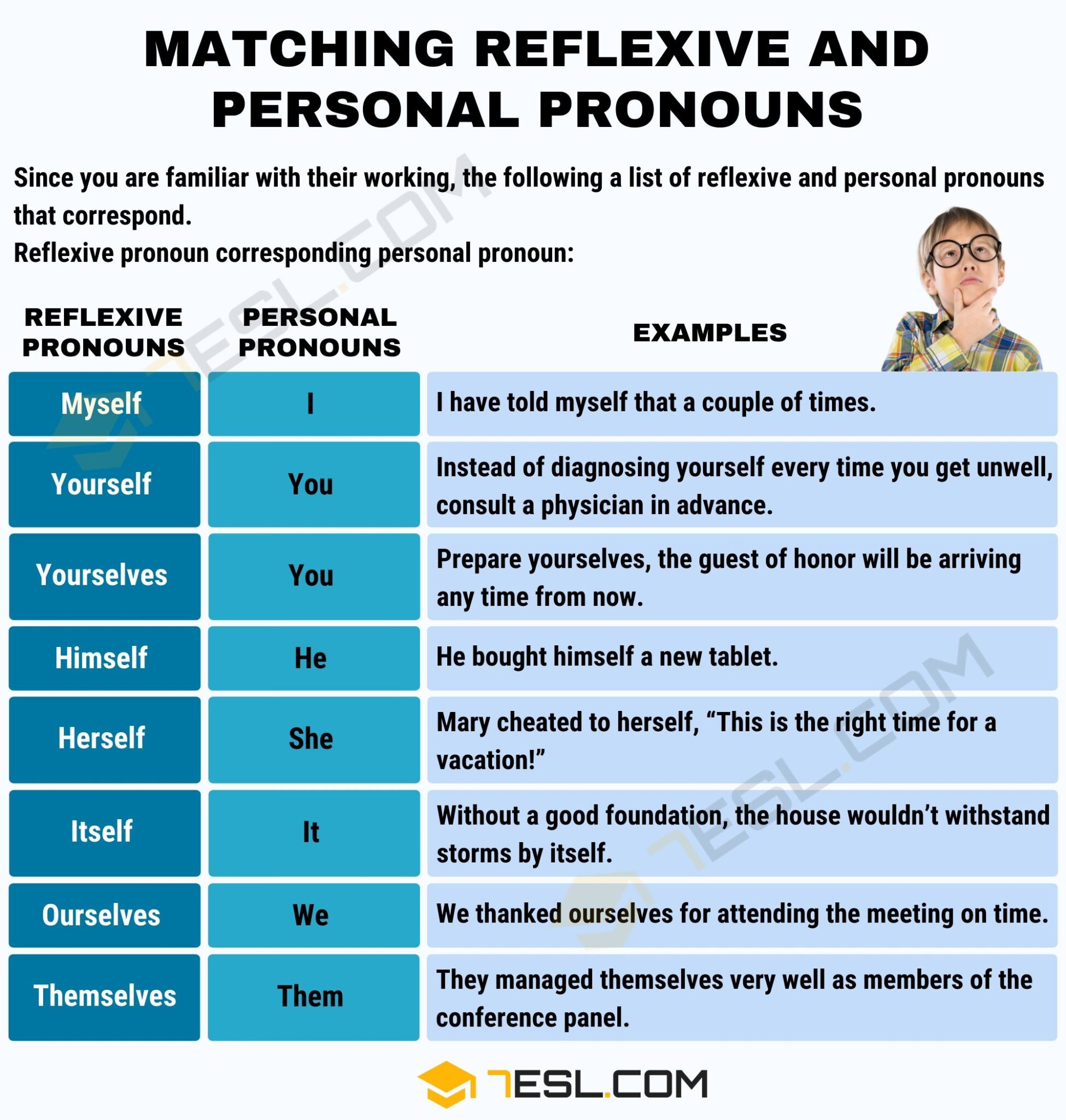
Since you are familiar with their working, the following a list of reflexive and personal pronouns that correspond.
Reflexive pronoun corresponding personal pronoun:
- Myself – I
- Yourself – You
- Yourselves – You
- Himself – He
- Herself – She
- Itself – It
- Ourselves – We
- Themselves – Them
The following are examples of each reflexive pronoun in sentences.
- I have told myself that a couple of times.
- Instead of diagnosing yourself every time you get unwell, consult a physician in advance.
- Without a good foundation, the house wouldn’t withstand storms by itself.
- We thanked ourselves for attending the meeting on time.
- He bought himself a new tablet.
- If she weren’t forcing herself to sleep late, she wouldn’t have excelled in her final exam.
- Prepare yourselves, the guest of honor will be arriving any time from now.
- They managed themselves very well as members of the conference panel.
- Mary cheated to herself, “This is the right time for a vacation!”
- I forced myself to get up today in the morning.
When to Use Reflexive Pronouns
Reflexive pronouns are, in most cases, used to determine whether the subject is performing an action by or to itself. Rather than exerting its action on a different object, the subject exerts the action on itself literally or figuratively.
This is more common whenever the third-person plural is being used. Let’s look at the following sentences:
- They misguided them.
- They misguided themselves.
In the first sentence, you’re not certain whether “them” is denoting to something different or referring back to “they,” which is the subject of the sentence.
In the second sentence, it’s evident who the subject “they” is referring to, and in this case, it refers to the reflexive pronoun “themselves.”
Reflexive pronouns can be used in conjunction with the word “by” to indicate “alone” or “with no help.” Here are the examples:
- I went to the Australian gardens by myself.
- The boys cleaned the room by themselves.
Reflexive Pronouns as Direct Objects
A reflexive pronoun qualifies to be a direct object if the subject and the direct object in a sentence are similar. Here is an example to illustrate this.
- Jason chose to reward Jacob with the unused smartphone.
- Jason chose to reward himself with the unused smartphone.
In the first example, Jacob (object) is the receiver of the reward. In the second sentence, Jason (subject) is the object that received the reward, thus the use of the reflexive pronoun himself.
Reflexive Pronouns as Indirect Objects
They can act as indirect objects in a sentence. Here is an example.
- Ann wakes up her younger brother every morning.
- Ann wakes herself every morning.
Always use reflexive pronouns in your writing to make it informative and engaging to your readers. Correct use of these pronouns is necessary if you’re to improve your grammar as well as your writing skills.
Reflexive Pronoun Infographic

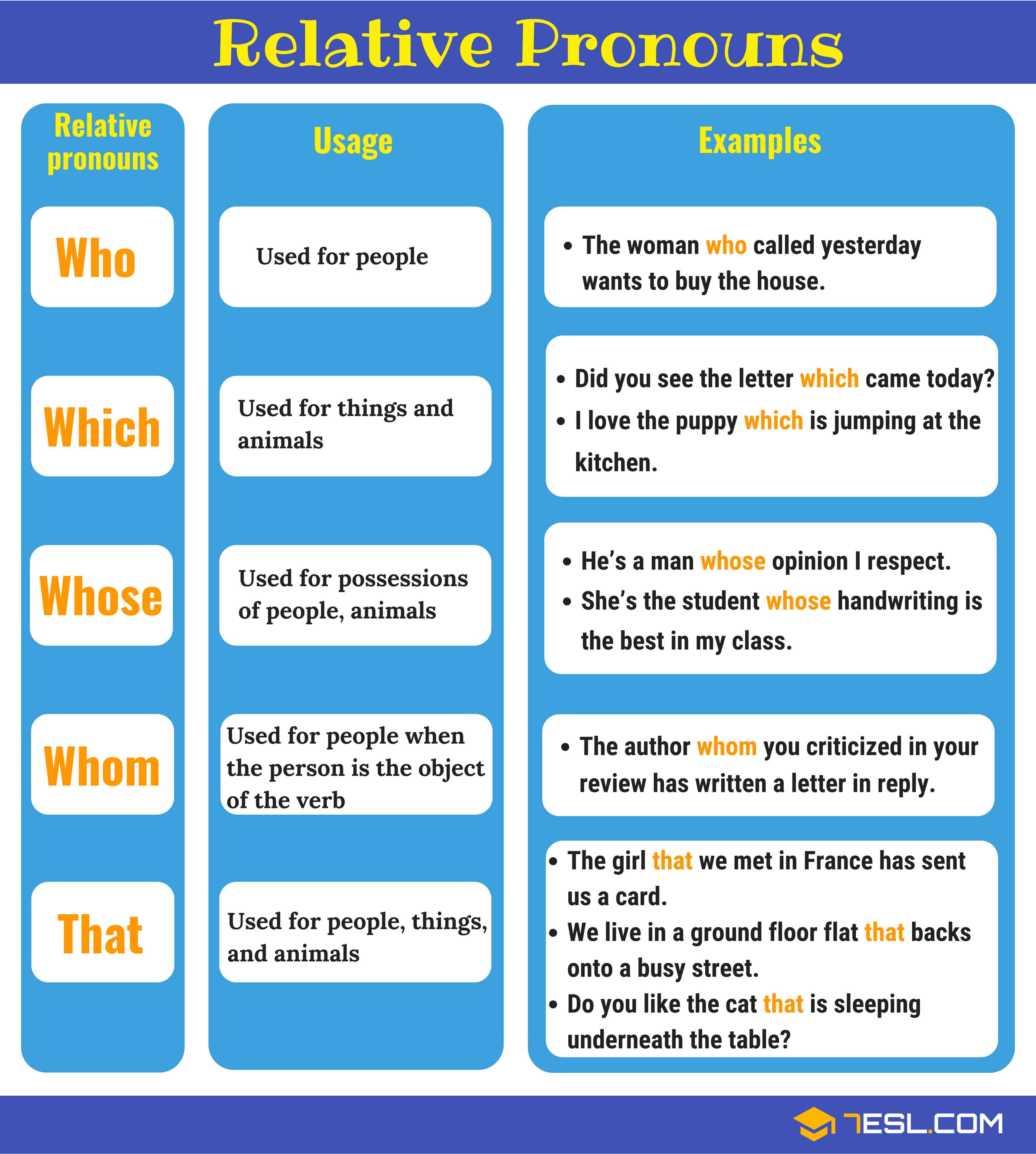
What is a Relative Pronoun?
What is a relative pronoun? A relative pronoun is a pronoun that relates to the word that it modifies and is not specific. In English, relative pronouns are who, whom, which, whose, and that.
A relative pronoun links two clauses into a single complex clause. It is similar in function to a subordinating conjunction. Unlike a conjunction, however, a relative pronoun stands in place of a noun.
Relative Pronouns List | Who, Whom, Whose, Which, That
Learn the relative pronouns list with useful grammar rules, example sentences and ESL picture.
Who
- Used for people
The woman who called yesterday wants to buy the house.
- Can act as the subject or the object of the relative clause
Cindy, who taught me English, has just got married. (who refers to Cindy and is the subject of taught in the relative clause)
I discussed it with my brother, who is a lawyer. (who refers to my brother and is the object of discussed in the relative clause)
Which
- Used for things and animals
Did you see the letter which came today?
I love the puppy which is jumping at the kitchen.
- Can act as the subject or the object of the relative clause
His best movie, which won several awards, was about the life of Gandhi. (which refers to the his best movie and is the object of won in the relative clause)
She can’t come to my birthday party, which makes me sad. (which refers to the whole sentence before it)
That
- Used for people, things, and animals (who and which can be replaced by that, which we use commonly in spoken English)
The girl that we met in France has sent us a card. (or who)
We live in a ground floor flat that backs onto a busy street. (or which)
Do you like the cat that is sleeping underneath the table? (or which)
- Can act as the subject or the object of the relative clause
I’ll tell you a secret that is very interesting. (that refers to a secret and is the subject of is in the relative clause)
This is the book that I buy. (that refers to the book and is the object of buy in the relative clause)
Whose
- Used for possessions of people, animals
He’s a man whose opinion I respect.
She’s the student whose handwriting is the best in my class.
Whom
- Used for people when the person is the object of the verb
The author whom you criticized in your review has written a letter in reply.
Note for Relative Pronouns
The best way to know which pronoun to use is to look at the noun before it.
For example:
“This is the car that I drove to Paris.” The noun before “that” is “car”, which is a thing, so we know we can use the pronouns “that” or “which”.
In the sentence “I know a woman who is a doctor.” The noun “woman” is a person, so we know we can use “who” or “that” after it.
Relative Pronoun Reduction
Relative pronouns can sometimes be left out; they are understood but not given in the sentence as in the following example:
I bought a book that my sister recommended.
If the relative pronoun is the subject of its clause, then it must be kept. Otherwise, the relative pronoun can generally be dropped.
Relative Pronouns | Image
Learn useful relative pronouns list with grammar rules and examples.