What Is a Noun Phrase?
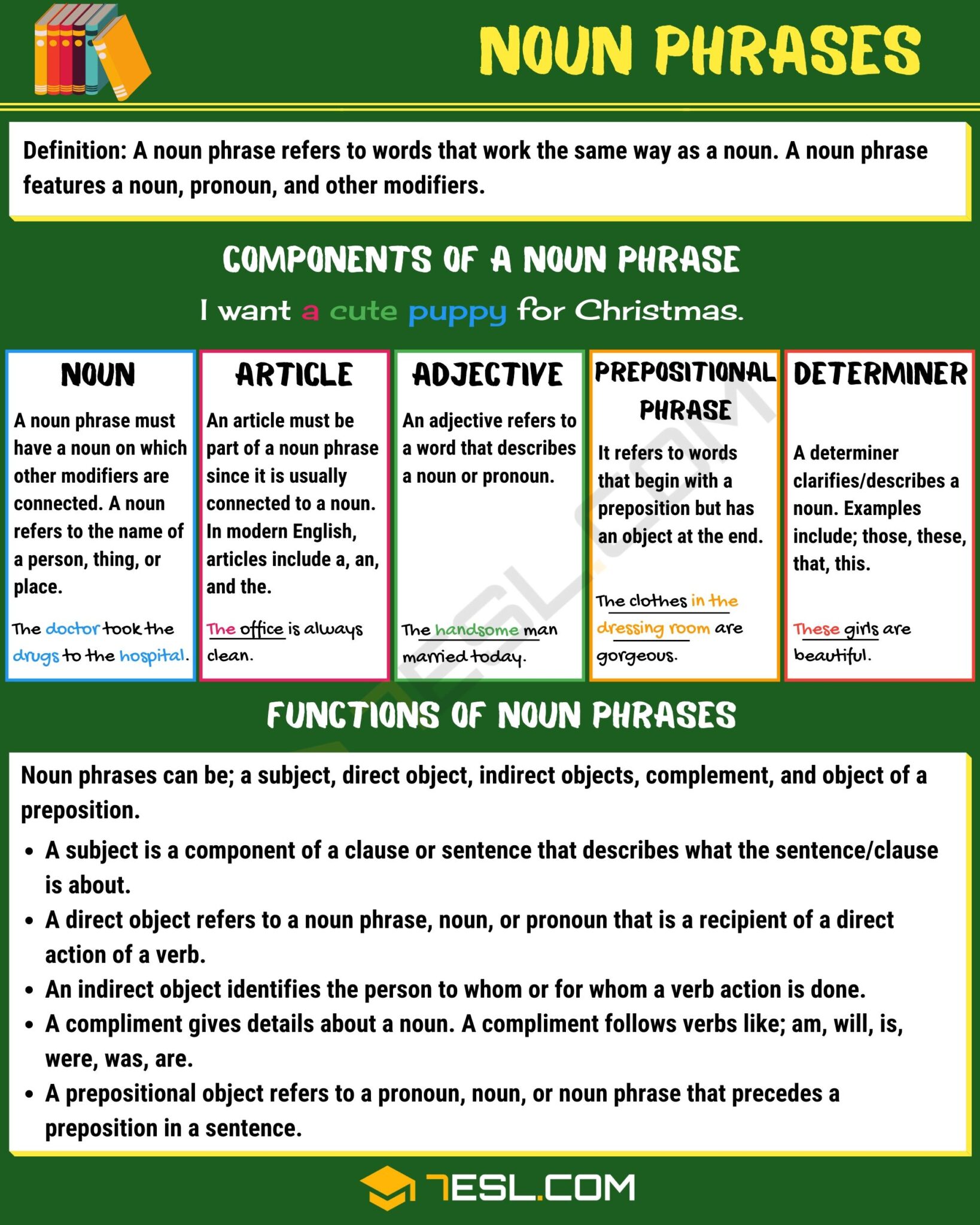
A noun phrase refers to words that work the same way as a noun. A noun phrase features a noun, pronoun, and other modifiers. In this case, a pronoun is used in place of a noun, and it could either be an indefinite pronoun or a subject pronoun. An indefinite pronoun refers to a pronoun that does not specify a particular place, person, or thing. Words like anybody, everyone, someone, and nothing are good examples of indefinite pronouns. A subject pronoun, on the other hand, is a personal pronoun lie I, she, and he. A noun refers to the name of a thing, place, or person. This article gives you more insights on noun phrases, take a close look.
Components of a Noun Phrase
A Noun
A noun phrase must have a noun on which other modifiers are connected. A noun refers to the name of a person, thing, or place.
- The doctor took the drugs to the hospital.
In this case, the nouns doctor, drugs, and hospital represent the names of a person, thing, and place, respectively.
An Article (modifier)
An article must be part of a noun phrase since it is usually connected to a noun. In modern English, articles include a, an, and the.
- The office is always clean.
In this noun phrase, there is an article the, which is joined to the noun office. The subject in this sentence is the office.
An Adjective (modifier)
An adjective refers to a word that describes a noun or pronoun.
- The handsome man married today.
In this case, the adjective is handsome, and it describes the man Both words form a noun phrase, and they are also the subject in the sentence.
Prepositional Phrase (modifier)
It refers to words that begin with a preposition but has an object at the end.
- The clothes in the dressing room are gorgeous.
The prepositional phrase in the sentence is in the dressing room It gives details about the location of the clothes and also modifies clothes.
Determiner
A determiner clarifies/describes a noun. Examples include; those, these, that, this.
- These girls are beautiful.
The determiner these describes the noun and forms the noun phrase these girls.
Functions of Noun Phrases
Noun phrases can be; a subject, direct object, indirect objects, complement, and object of a preposition.
As a Subject
A subject is a component of a clause or sentence that describes what the sentence/clause is about.
- Very many broken cars remain in the garage.
The subject in this sentence is very many broken cars since the sentence wishes to describe the cars. It is also a noun phrase in the sentence.
As a Direct Object
A direct object refers to a noun phrase, noun, or pronoun that is a recipient of a direct action of a verb.
- They bought books for the whole class.
The direct object is book, and it directly receives the action of the verb bought The phrase for the whole class also becomes part of the noun phrase.
As an Indirect Object
An indirect object identifies the person to whom or for whom a verb action is done.
- Mary cooked her weak, sickly grandmother some food.
The indirect object is the noun phrase, in this case, is weak, sickly grandmother, and it receives the food. The food is the direct object since it gets the verb action cooked.
As a Compliment
A compliment gives details about a noun. A compliment follows verbs like; am, will, is, were, was, are.
- The best African clothes to wear are colorful and gorgeous, Ankara.
The noun phrase colorful and gorgeous Ankara is the compliment that gives more details about the best African clothes to wear It also complements the noun phrase African clothes.
As an Object of the Preposition
A prepositional object refers to a pronoun, noun, or noun phrase that precedes a preposition in a sentence.
- John drives to a dirty home daily.
The noun phrase in the sentence is a dirty home The preposition is to.
Noun phrases generally serve similar purposes as a noun. It comprises of a noun/ pronoun and other modifiers. It is impossible to have a noun phrase that doesnt have a noun/ pronoun. Noun phrases can act as a subject, a direct object, an indirect object, a compliment, and a prepositional object. Noun phrases help one write descriptive information in a sentence without being wordy, and they also make sentences enjoyable.
Noun Phrases | Picture