What is a preposition?
Prepositions are words that tell how one thing is relating to or interacting with another. For example, “The man sat on the chair.” The preposition in this sentence is on. Prepositions tell us where something is in relation to something else. The man isn’t under the chair, for example. He’s on it.
They can also be a little bit more abstract. For and to are both prepositions, as is despite. Sometimes, it seems like prepositions are the miscellaneous words that don’t fit anywhere else. There really are rules, though, and examples of prepositions help more than anything.
Many prepositions have nearly the exact same meaning. This makes them tricky to use properly unless you read or listen to a lot of English. This will help you recognize, for example, when to use on versus when to use in. At and to are also commonly mistaken for one another. There aren’t always specific rules to memorize so much as phrases and learning which prepositions go with which words.
If you study propositions, you’ll probably see a lot of people who claim that you shouldn’t end a sentence with a preposition. That’s not actually true. It’s fine to end a sentence with a preposition, as long as it’s not just an extra word that isn’t needed. For example, “Where is the dog at?” does not need that last word, which happens to be a preposition. It should be removed. Those are the only types of prepositions to watch for at the end of sentences.
Preposition List
There are around 150 prepositions in the English language, and we’re going to list all of them we could find. They are broken down into categories of prepositions, based on how that type of preposition functions.
This list contains one-word prepositions as well as complex prepositions. Complex prepositions are when more than one word works together as a preposition. This is not the same as a prepositional phrase, which is a phrase starting with a preposition but ending in a noun.
Some of these prepositions can function in multiple categories, depending on how they’re used. They will appear in more than one list.
Some of these words also fit into other speech categories, especially adverbs and conjunctions.
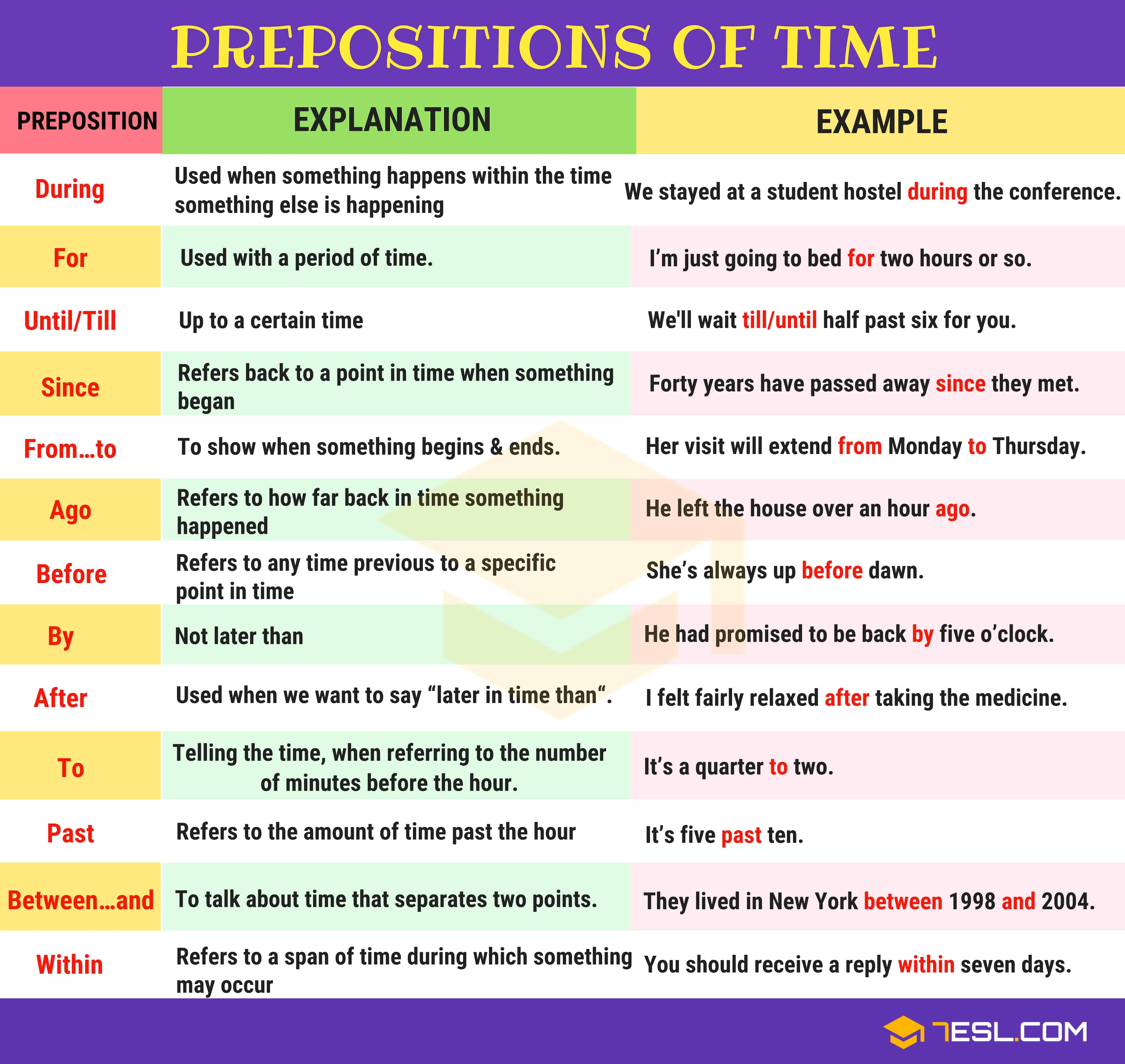
List of Prepositions of time
Prepositions of time are prepositions that we use to indicate something’s relationship with time.
- About
- After
- Ago
- Around
- At
- Before
- By
- Circa
- During
- Following
- For
- From
- Gone
- In
- On
- Past
- Prior to
- Since
- Until/till
- Up to
- Up until
List of Prepositions of Place
Prepositions of place are ones that tell where one thing is in space compared to another.
- Aboard
- Above
- Across
- Against
- Alongside
- Amid
- Among
- Apart from
- Astride
- At
- Atop
- Behind
- Below
- Beneath
- Beside
- Between
- Beyond
- By
- Close to
- Far
- Far from
- Forward of
- From
- In
- In between
- In front of
- Inside
- Into
- Minus
- Near
- Near to
- Next to
- Of
- Off
- On
- On board
- On top of
- Onto
- Upon
- Opposite
- Out
- Out of
- Outside
- Outside of
- Over
- Round
- Through
- Throughout
- To
- Together with
- Toward/towards
- Whether this word ends with an -s depends on what region’s English is being used.
- Under
- Underneath
- Up against
- With
- Within
- Without
List of Prepositions of Movement
Prepositions of movement (also known as prepositions of direction) tell how something moves in relation to another thing. Many of these are also prepositions of place. Prepositions of place tell where something is, and prepositions of movement tell how something is moving.
- Above
- Across
- Against
- Ahead
- Along
- Along with
- Amid
- Around
- Away
- Away from
- Behind
- Below
- Beneath
- By means of
- Down
- Further to
- In between
- Into
- Off
- Off of
- On
- Onto
- Over
- Out of
- Past
- Round
- Through
- Toward/towards
- Under
- Up
- Via
List of Prepositions of Manner and Phrase
Prepositions of manner (also known as prepositions of agency or prepositions of instrument) tell us how something is done. This category also includes many legal phrases and whether or not people are includes or excluded.
- About
- According to
- Anti
- As
- As for
- As per
- As to
- As well as
- Aside from
- Bar
- Barring
- Because of
- Besides
- But for
- By
- But
- Concerning
- Considering
- Contrary to
- Counting
- Cum
- Depending on
- Despite
- Due to
- Except
- Except for
- Excepting
- Excluding
- Given
- In addition to
- in case of
- In face of
- In favor of/in favour of
- In light of
- In spite of
- In view of
- Including
- Instead of
- Less
- Like
- Notwithstanding
- Of
- On account of
- On behalf of
- Other than
- Owing to
- Pending
- Per
- Plus
- Preparatory to
- Pro
- Re
- Regarding
- Regardless of
- Save
- Save for
- Saving
- Than
- Thanks to
- Unlike
- Versus
- With
- With reference to
- With regard to
- Worth
List of Prepositions | Image
Full prepositions list in one table

List of Prepositions (with Examples)
Examples of Prepositions in Sentences
The following are some examples of prepositions being used in sentences. There is one example for each category of preposition we include in the list of prepositions below.
That happened during the 1900s.
This is a preposition that shows how the event relates to time. Prepositions of time have a lot of overlap with adverbs, and many words are listed as both adverbs and prepositions.
The ball is on the box.
This preposition shows where the ball is in relation to the box. It is a preposition of place.
He ran around the corner.
This preposition tells how he moved in relation to the corner. It is a preposition of movement or direction.
She wrote the paper with Sarah.
This preposition tells the manner in which the paper was written in relation to these two people. This category is a little more open, and it’s named differently according to who you consult. It primarily focuses on how people or things relate to functioning together. This category of prepositions often includes words that are also conjunctions.
Prepositions of Place
List of Prepositions of Place with Examples
Learn a prepositions list with pictures, meaning, and example sentences.
In

Meaning: Used with the name of a container, place, or area to say where someone or something is
Example: There is some milk in the fridge.
On

Meaning: Touching a surface or being supported by a surface
Example: He sat on the chair.
Under

Meaning: Lower than (or covered by) something else
Example: She was hiding under the table.
Next to

Meaning: Further forward than someone or something else.
Example: There was a little girl sitting next to him.
Between

Meaning: Something in the middle of two objects or things (or places)
Example: The English Channel is between France and England.
Among

Meaning: In the middle of or surrounded by other people or things
Example: Mary is popular among the students.
In front of

Meaning: Further forward than someone or something else
Example: I can’t see because of the person in front of me.
Behind

Meaning: At the back (part) of something
Example: He put his hands behind his back.
Above

Meaning: In a higher position than something else
Example: The helicopter hovered above the house.
Below

Meaning: Lower than something else
Example: A small stream runs below that bridge.
Near

Meaning: Near and close to are similar to next to/beside but there is more of a distance between the two things
Example: Our house is near the supermarket.
Far from

Meaning: A long distance away
Example: The restaurant is not far from here.
At

Meaning: Used to say exactly where something or someone is
Example: She lost her earrings at the door.
Preposition List with Pictures
List of prepositions of place in one pictur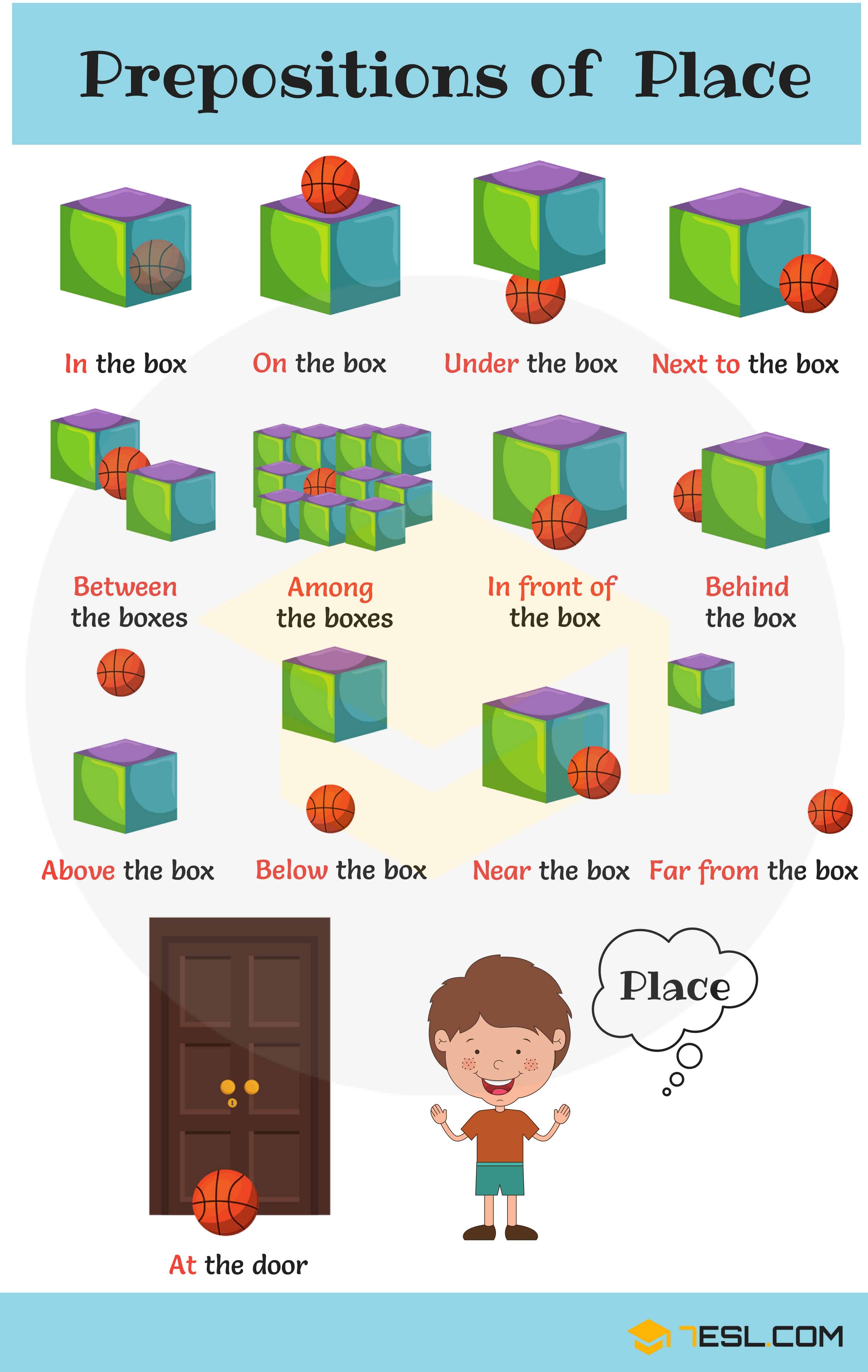
Prepositions of Movement
List of Prepositions of Movement with Examples
Learn prepositions list with pictures, meaning, and example sentences.
Down

The preposition down indicates movement from a higher to a lower position.
Example: It came down the stairs.
Up

The preposition up indicates movement from a lower to a higher position.
Example: It went up the stairs.
Out of

The preposition out of indicates movement from inside a space to outside a space.
Example: She flounced out of the house.
Into

The preposition into refers to movement from the outside to the inside of a three dimensional space and it can be used to express the idea of movement in the direction of something, often resulting in actually hitting it.
Example: We went into the shop on the corner.
Toward

The preposition toward is used to say that someone or something moves, looks, faces,… in the direction of someone or something.
Example: He was standing with his back toward me.
Away

The preposition away is used to say that someone leaves a place or person, or stays some distance from a place or person.
Example: She turned away and stared out of the window.
Past

The preposition past describes a movement at the far side of something or beyond something.
Example: Walk past the theater on the right and the bank is on the left.
Over
 Pin
Pin
The preposition over is used to talk about movement from one side of a place to another. It usually refers to movement in relation to two-dimensional surfaces (a lawn, lake, table etc) or to show when something is positioned on the opposite side of a line (a river, bridge, road etc).
Example: The cat jumped over the wall.
Onto

The preposition onto used to show movement into or on a particular place.
Example: The cat jumped onto the roof.
Off

The preposition off describes a movement away from something.
Example: We get off the train at the next stop.
Around

The preposition around refers to going along its edge in a circular direction.
Example: You must drive around the city center to reach the cinema.
Under

The preposition under describes a movement below the surface of something.
Example: The cat is under the table.
Along

The preposition along is used to show movement following a line, it is also sometimes used to show a specific position in relation to a line or to show when things are positioned in a line.
Example: He’s walking along the path.
Across

The preposition across is used for describing a position that is stretching from a certain place to the other or from one side to the other.
Example: You must walk across the street at the crosswalk.
Through

The preposition through is used for describing movement from particular point to the other or from one end to the other.
Example: The car went through the tunnel.
Preposition List with Pictures
List of prepositions of movement in one picture

Prepositions of Time
List of prepositions of time with examples.