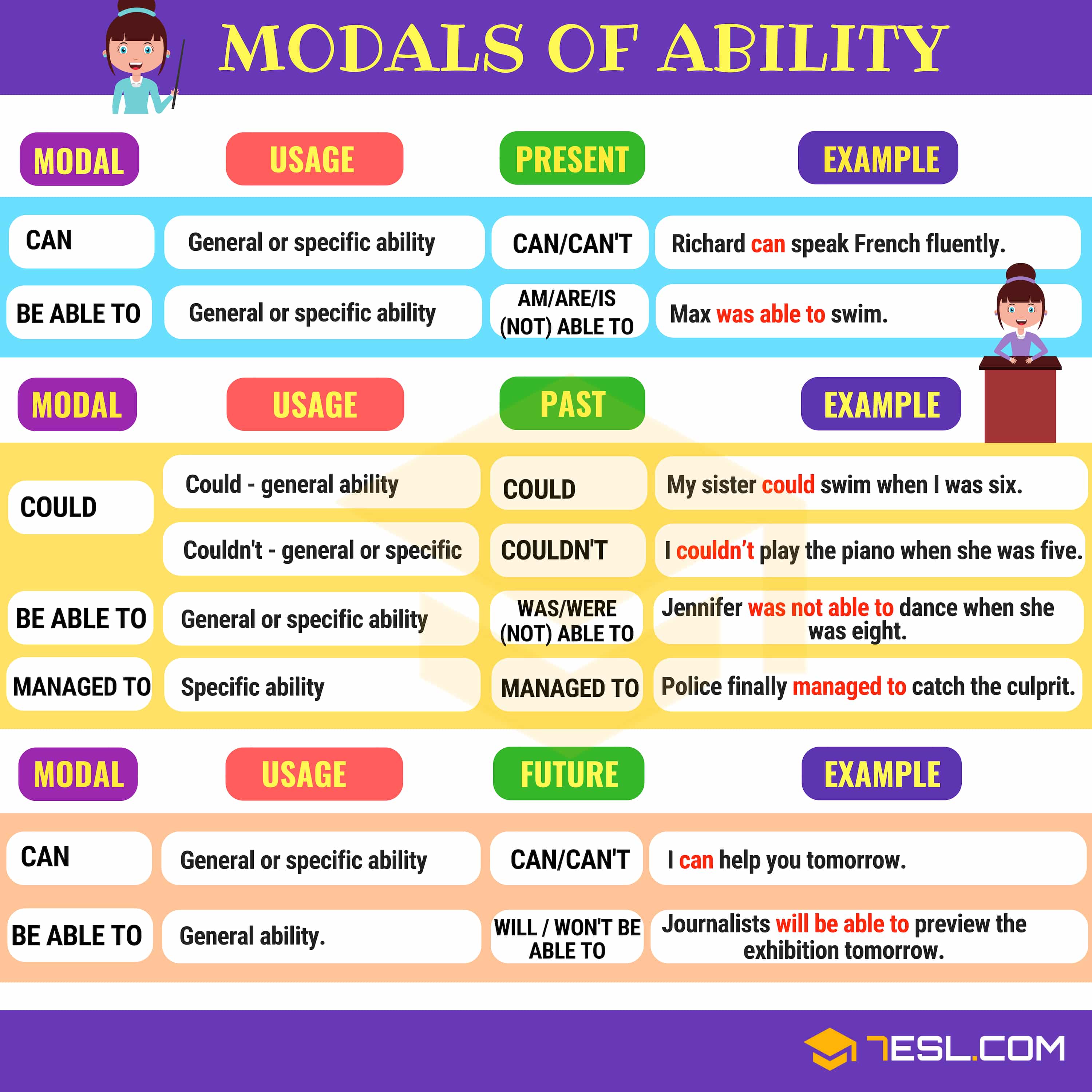
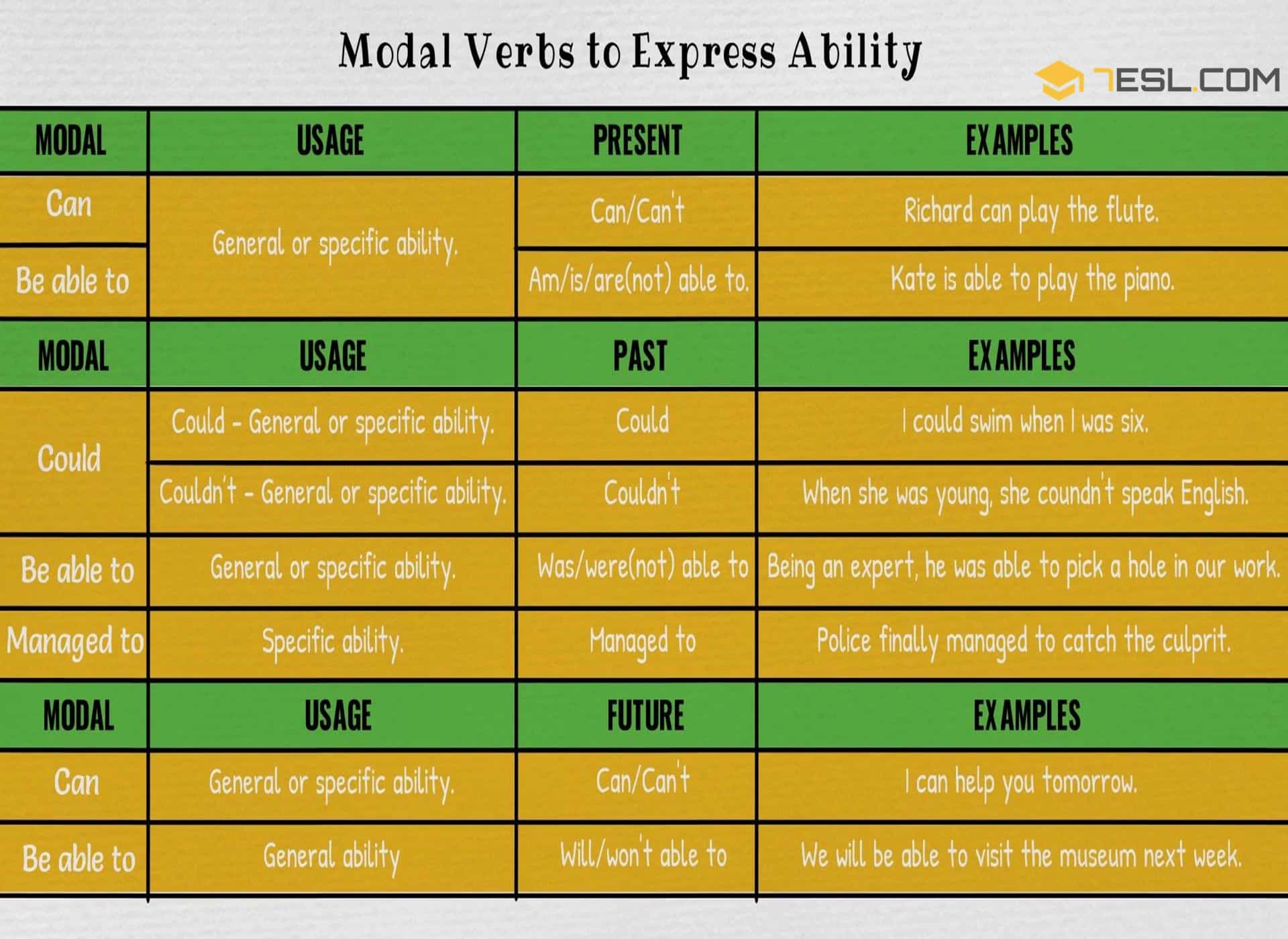
Ability can be expressed using modal verbs and phrases.
Present Forms | Modals of Ability
Be able to
- Form:
Is/am/are(not) able to + main verb
- Usage:
This form may be used in positive or negative, for general or specific ability.
- Modal verb examples:
James is able to cook steak.
David is not able to cook steak.
Can/Can’t
- Form:
Can/Can’t + main verb
- Usage:
This form may be used in positive or negative, for general or specific ability.
- Examples:
Richard can speak French fluently.
Gabriella can’t speak French fluently.
Past Forms | Modals of Ability
Be able to
- Form:
Was/were(not) able to + main verb
- Usage:
This form may be used, in positive or negative, for general or specific ability.
- Examples:
Max was able to swim fast when he was a young boy.
Jennifer was not able to dance when she was eight.
Could/Couldn’t
- Form:
Could/Couldn’t + verb
- Usage:
Could, in positive, is only used for general ability.
Couldn’t is used for general or specific.
- Examples:
I could swim when I was six.
My sister couldn’t play the piano when she was five.
Managed to
- Form:
Managed to + verb
- Usage:
This form is only used for specific ability: one time, one situation.
- Example:
Police finally managed to catch the culprit.
Future Forms | Modals of Ability
Be able to
- Form:
Will/won’t able to + main verb
- Usage:
This form is only used for general ability.
- Example:
Journalists will be able to preview the exhibition tomorrow.
Can/can’t
- Form:
Can/Can’t + verb
- Usage:
This form may be used, in positive or negative, for general or specific ability.
- Examples:
I can help you tomorrow.
I can’t come to her birthday party.
Modals of Ability | Image