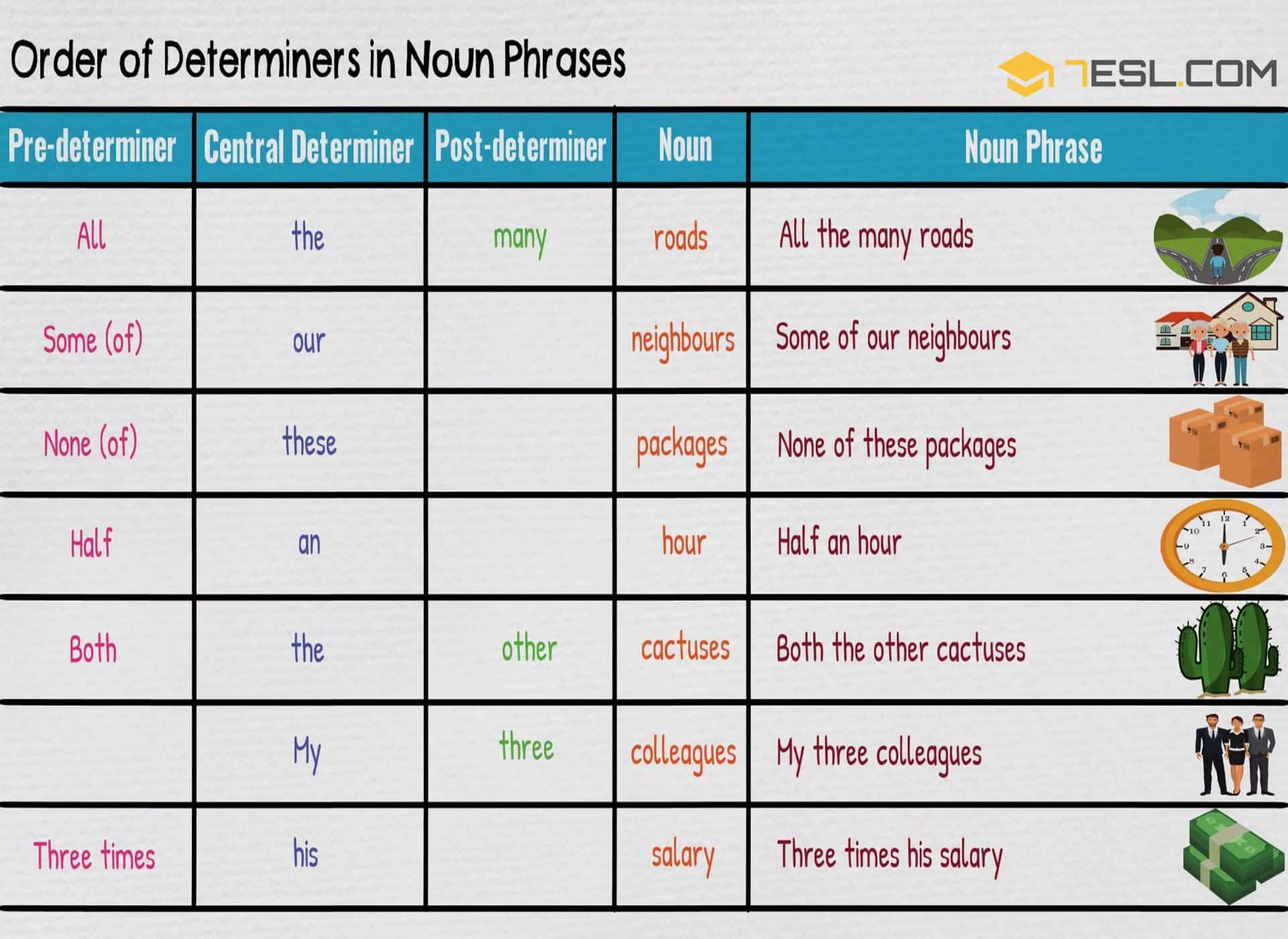
Determiners can be used in certain combinations as follows:
- A definite determiner can be followed by certain quantifiers
Examples: The many problems, these three things, my very few faults.
- The words all and both can be followed by a definite determiner
Examples: all the green apples, both the boys.
- The word all can be followed by a cardinal number
Example: all three things.
- The word some can be followed by a cardinal number
Examples: some eight packets
- Words and phrases expressing fractions and multiples, such as half, double, twice, three times, etc. can be followed by a definite determiner
Examples: half a minute, double the risk, twice my age, three times my salary, three-quarters the diameter, etc.
- The word many can be used with the indefinite article and a singular noun.
Examples: many a night, many an awkward moment.
- The words each and every can be followed by a cardinal number or other expression of definite quantity.
Examples: each two seats, every five grams of flour.
- To specify a quantity within a definite class, it is often possible to use a quantifier in pronoun form, followed by of and a definite determiner.
Examples: three of the mice, few of my enemies, none of these pictures.
An alternative construction with possessives is to place of and the pronoun form of the possessive after the noun: few enemies of mine, much information of John’s.
- As with other parts of speech, it is often possible to connect determiners of the same type with the conjunctions and and or.
Examples: his and her children, two or three beans.
Order of Determiners in Noun Phrases | Picture