Predicate Adjectives and Attributive Adjectives
The parts of speech are quite complex. In addition to the basic parts themselves, they divide into smaller categories that describe their uses in English in more detail. Adjectives, though seemingly straightforward, are no different.
Adjectives have many uses in English. In previous studies, you may have come across, and used, attributive adjectives, since they sound more direct in writing. The major difference is that attributive adjectives tend to come right before the noun they describe, whereas predicate adjectives appear after a linking verb.
Today well be covering predicate adjectives, We first have to understand a few basic things about the formation of a sentence before getting to the definition.
A sentence containing a predicate adjective always has a subject and a linking verb. The subject of a sentence is usually a noun, pronoun or noun phrase and easy to identify. A linking verb connects the noun or phrase to a description, which usually is the predicate adjective. Although the subject can be anything, there are a limited number of linking verbs in English so predicate adjectives are uncomplicated to find.
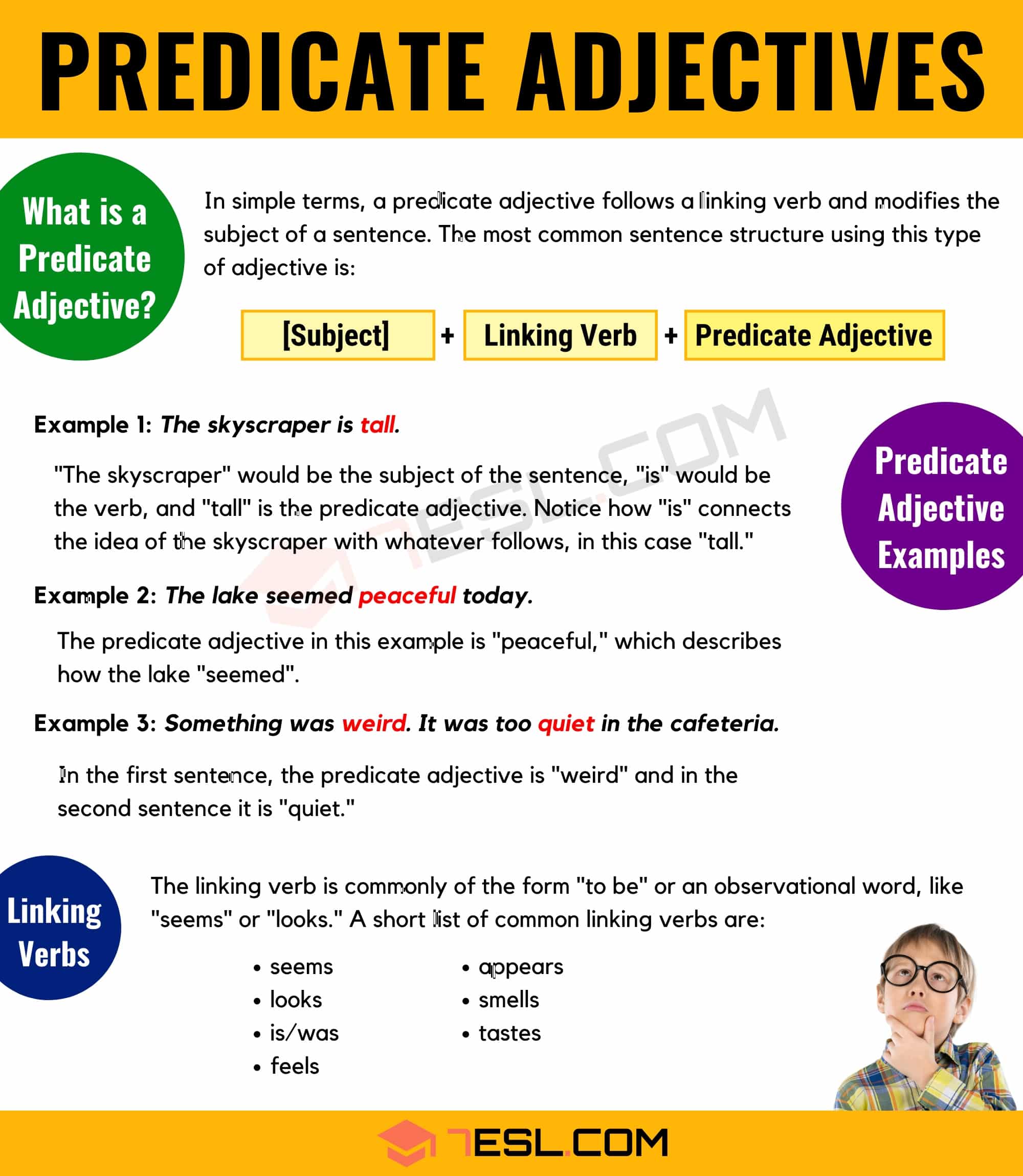
What is a Predicate Adjective?
In simple terms, a predicate adjective follows a linking verb and modifies the subject of a sentence. The most common sentence structure using this type of adjective is:
[Subject] + Linking Verb + Predicate Adjective
More information can come after the adjective, but lets keep things light for now. We start the sentence with the subject, use a linking verb to make a connection with a description, and finish the thought with that description. Now lets look at a live example.
Predicate Adjective Examples
Example 1: The skyscraper is tall.
The skyscraper would be the subject of the sentence, is would be the verb, and tall is the predicate adjective. Notice how is connects the idea of the skyscraper with whatever follows, in this case tall. Another example:
Example 2: The lake seemed peaceful today.
You guessed it: the predicate adjective in this example is peaceful, which describes how the lake seemed. One more example:
Example 3: Something was weird. It was too quiet in the cafeteria.
A double whammy! In the first sentence, the predicate adjective is weird and in the second sentence it is quiet.
Linking Verbs
Notice that the linking verb is commonly of the form to be or an observational word, like seems or looks.
A shortlist of common linking verbs are:
- seems
- looks
- is/was
- feels
- appears
- smells
- tastes
- gets
- comes
And once again, see how they usually refer to our five senses. Not all linking verbs are this simple, however. Take a look at these three examples:
- The leaves will turn yellow soon.
- Close the window so the temperature stays warm.
- This proves nothing.
Will turn, stays, and proves all act as linking verbs in the above sentences.
Train Your Eye
Spotting predicate adjective is much easier than you think. The next time you read, try locating linking verbs and then analyzing what the adjective is. Youll end up a pro in no time.
Predicate Adjective | Infographic