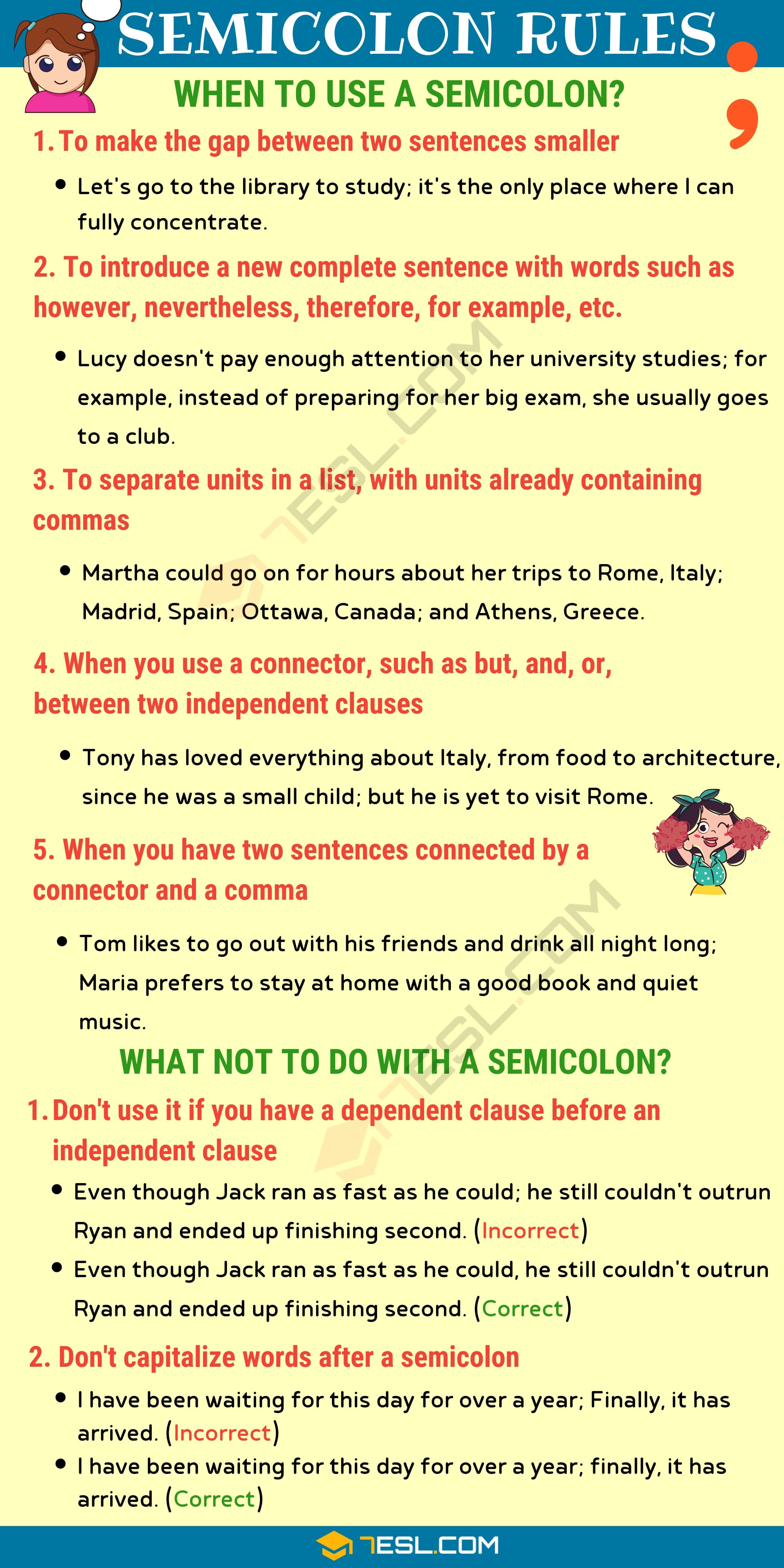
As we’ve already mentioned, there are really only two reasons you would need to use a semicolon:
1) As part of a list that is more complicated because it provides additional details.
2) To join two independent clauses that have a similar theme or idea but could work separately as two sentences in their own right.
When to Use ;
Using a Semicolon as Part of a List
Unlike a colon, which is usually used to introduce the list, a semicolon is used to separate information within a list. Here’s an example of a list that would simply require a colon and commas to be properly punctuated:
- Can you bring three items back from the store: apples, milk, and chocolate?
Because it is a simple list above, a colon and commas work just fine. If they provided additional information about each individual item in the list, it would need semicolons instead. Like this:
- Can you bring three items back from the story: apples for our dessert tomorrow night; milk for the children’s cereal tomorrow morning; and chocolate for a bit of a treat tonight?
Notice how a colon was used to start the list, but a semicolon thereafter. That’s because typically in lists, it is the commas that a semicolon replaces, not the colon itself. Although it would have been grammatically correct if you removed the emphasis in the first part of the sentence to write something like this:
- Can you bring me apples for our dessert tomorrow night; milk for the children’s cereal tomorrow morning; and chocolate for a bit of a treat tonight?
Because we have removed the emphasis of the list style (“three items”), you can just use semicolons without a colon being necessary.
Using a Semicolon to Connect Two Independent Clauses
Just like a colon, you can use a semicolon to join two ideas together. The difference is, a colon is used to emphasize the second part of the sentence after the colon, but you use a semicolon to show that the ideas are connected and are of equal weight in terms of their importance in the sentence. Here’s how it would work:
- It was a lovely day out; the sun was shining down, reflecting off the ocean’s waves.
The semicolon here shows that it connects the two independent clauses, and they are equally important. If we wrote it like this:
- It was a lovely day out: the sun was shining down, reflecting off the ocean’s waves
We would show that the second part of the sentence was more important than the first, which might not be the message we want to send to our readers.
Remember when using a semicolon to connect two ideas together, we are saying they are equally important ideas of the same value.
When Not to Use a Semicolon
The most common mistake that people make is when they use a semicolon in place of a colon or comma. These are the two major ways you will accidentally misuse a semicolon. So, we’ll highlight the differences so you don’t make the mistakes that most people do.
Mixing Semicolons and Colons
This is the most common mistake to make, because they are so similar in terms of how they look, and in how they function within a sentence. The easiest way to remember the difference is that you should only use colons to introduce lists, but you can use semicolons as part of a list. When connecting two independent clauses as in the examples above, colons show emphasis, and semicolons show equality in terms of their importance.
Semicolons vs. Commas
The second most common mistake writers make with semicolons is mixing them up with commas. This is most common in lists following a colon. If the information in the list is complicated because it supplies additional information, then a semicolon is necessary. You use a comma when the list is simple. Here’s how they would both look correctly:
- You will need to bring these items: a pencil, a notebook, and an eraser. (Correct)
- You will need to bring these items: a pencil for completing the written part of the exam; a notebook for you to jot down any additional information you require; and an eraser to correct any mistakes that you make. (Correct)
You might also wonder why we don’t use a comma instead of a semicolon when connecting two independent clauses. The major reason is that semicolons show the two are connected and equally important, but you don’t use a coordinating conjunction between the two. When you use a coordinating conjunction, you use a comma instead of a semicolon. Like this:
- The students completed the exam; the teacher marked their homework. (Correct)
- The students completed the exam, whilst the teacher marked their homework. (Correct)
Don’t Use Semicolons If You Have a Dependent Clause before an Independent Clause
If you have a dependent clause in a sentence, don’t use a semicolon. The reason is pretty obvious: you simply don’t need to separate a dependent clause from an independent one that much. In fact, if you make such a big pause that a semicolon suggests, you’ll only make your writing more confusing. Nothing more than a comma is needed.
For example:
- Even though Jack ran as fast as he could; he still couldn’t outrun Ryan and ended up finishing second. (Incorrect)
- Even though Jack ran as fast as he could, he still couldn’t outrun Ryan and ended up finishing second. (Correct)
When To Use a Semicolon | Image